


Fuel surcharges are one of the most common accessorials of parcel shipping costs. For many shippers, they quietly add to annual spend while making budgets harder to forecast and margins harder to protect.
They often feel small at the package level—but at scale, fuel surcharges can materially change your total landed cost and erode profitability if they’re not actively monitored.
Here’s why fuel surcharges deserve more attention:
- Fuel surcharges are a major driver of total shipping cost—not a minor adjustment
- They compound across transportation and accessorial fees, increasing effective rates
- Weekly and monthly updates make forecasting difficult without normalized data
- Visibility, auditing, and modeling are essential—not optional for cost control
This guide breaks down what fuel surcharges are, why they exist, how major carriers calculate them, and how shippers can manage their impact.
What is a Fuel Surcharge?
A carrier fuel surcharge is an additional fee that shipping companies like FedEx, UPS, and DHL add to shipments to account for changes in fuel costs. Instead of constantly adjusting base transportation rates, carriers use fuel surcharges as a flexible pricing mechanism tied to external fuel indexes.
Key characteristics of fuel surcharges:
- Applied on top of base transportation rates
- Usually calculated as a percentage, not a flat fee
- Often applied to accessorial charges as well (e.g., residential delivery, delivery area surcharges)
- Updated frequently—often weekly
Because fuel surcharges compound on multiple line items, their real cost impact is often larger than shippers expect.
For high-volume parcel programs, fuel surcharges are a material driver of total landed cost and a critical input into pricing, forecasting, and carrier strategy.
Why Fuel Surcharges Exist
Fuel surcharges originated during periods of extreme fuel price volatility—most notably the oil crises of the 1970s. At the time, fuel was one of the largest and least predictable operating costs for transportation providers.
Historically, fuel costs were embedded in base rates. When fuel prices spiked, those fixed rates quickly became unprofitable. Fuel surcharges emerged as a way to separate fuel volatility from core transportation pricing.
This structure allowed carriers to adjust fuel-related costs quickly, avoid frequent contract renegotiations, and maintain transparency by isolating fuel as a distinct line item.
What began as a temporary solution became a permanent fixture of parcel pricing as fuel prices continued to fluctuate over time.
The Role Fuel Surcharges Play Today
Today’s parcel pricing environment has changed significantly. Fuel surcharges are no longer a secondary adjustment; they are one of the primary levers carriers use to protect margins.
Several trends stand out:
- Surcharges are expanding: Fuel now sits alongside demand, peak, delivery area, and package-related surcharges.
- Cadence varies by carrier: Weekly vs. monthly updates increase volatility and complexity.
- The “double hit” effect: Base rate increases plus higher surcharge application drive up total delivered cost.
The result is higher effective shipping rates and invoices that are harder to reconcile and forecast.
For shippers, this shift makes visibility and normalization essential. Without separating base rates from fuel and accessorials, it’s nearly impossible to understand what’s actually driving cost increases.
How are Fuel Surcharges Calculated?
Fuel surcharges are calculated using carrier-published tables tied to external fuel price indexes.
At a high level, the process works like this:
- The carrier tracks a published fuel benchmark (diesel or jet fuel).
- Fuel price ranges map to predefined surcharge percentages.
- As fuel prices move between ranges, the surcharge percentage adjusts.
- The surcharge is applied as a percentage add-on to shipping charges—and often to accessorials.
The methodology is predictable in structure, but the dollar impact changes constantly as fuel prices fluctuate.
How Major Carriers Calculate Fuel Surcharges
FedEx Fuel Surcharges
FedEx ties fuel surcharges to different benchmarks depending on the service:
- Ground & Home Delivery: U.S. on-highway diesel fuel
- Express (air): U.S. Gulf Coast jet fuel
FedEx publishes surcharge tables that link fuel price ranges to surcharge percentages. These rates are typically updated weekly and applied as a percentage to transportation charges and certain accessorials.
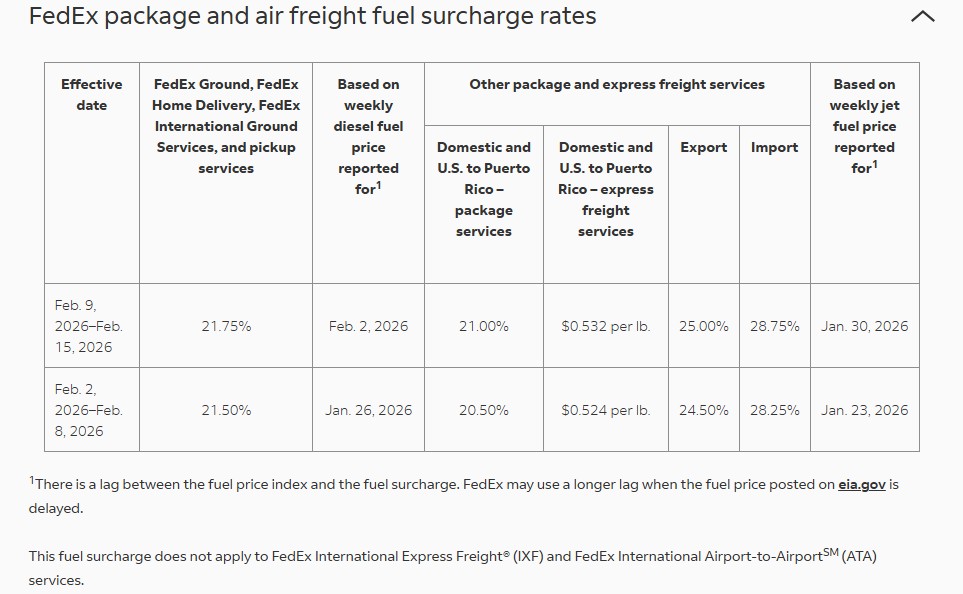
The approach closely tracks real-world fuel costs while keeping base rates separate from fuel volatility.
UPS Fuel Surcharges
UPS also uses an index-based system tied to publicly available fuel data:
- Ground services: National U.S. average on-highway diesel fuel
- Air services: U.S. Gulf Coast jet fuel
Fuel surcharge percentages are updated weekly based on published tables. Once set, the surcharge applies to transportation charges and select accessorial fees.
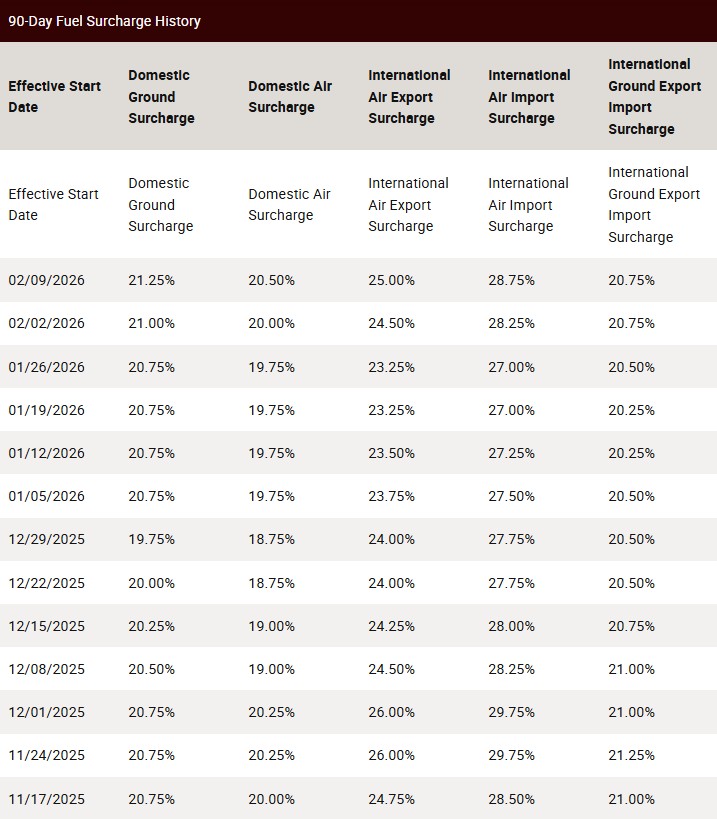
Like FedEx, UPS isolates fuel volatility from core pricing, which protects carriers—but increases complexity for shippers managing total cost.
How DHL Calculates Fuel Surcharges
DHL typically updates fuel surcharges on a monthly cadence rather than weekly.
- Ground-focused services: reference diesel fuel indexes
- Air and international services: reference jet fuel benchmarks
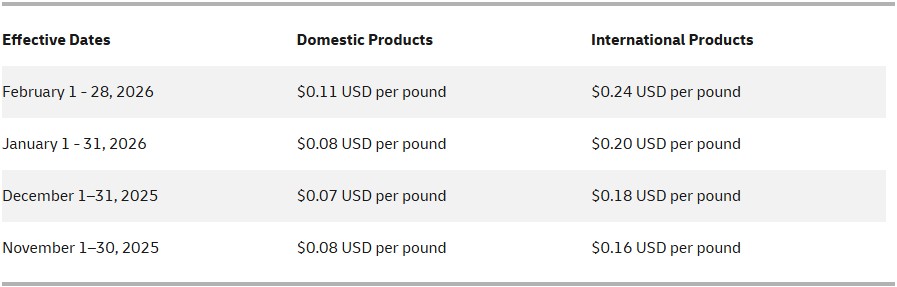
Depending on the service, surcharges may be percentage-based or assessed per shipment. The monthly cadence adds predictability, but the surcharge remains a separate and variable cost line.
5 Ways Shippers Can Manage Fuel Surcharges
Fuel surcharges aren’t fully controllable, but they are manageable with the right data and discipline.
1. Measure Fuel as Its Own Cost Driver
Track average fuel surcharge per shipment by carrier, service, and lane. Separating fuel from base rates reveals true cost drivers and prevents surprises.
2. Audit for Accuracy
Because fuel surcharges often apply to multiple line items, misapplication is common. Regular invoice auditing helps catch errors and prevent ongoing leakage.
3. Use Operational Levers
Shifting volume from air to ground, consolidating shipments, or adjusting timing outside peak windows can materially reduce fuel exposure.
4. Build Fuel into Forecasts
Fuel volatility should be baked into budgets, pricing models, and margin assumptions—not absorbed reactively after the fact.
5. Model Total Landed Cost
When evaluating carriers or service changes, always compare base rates plus current surcharge structures. The cheapest rate card isn’t always the lowest-cost option.
Sifted Helps You Take Control of Fuel Surcharges
SiftedAI helps you treat fuel surcharges as a measurable, manageable input to your parcel strategy—not a variable you simply absorb.
Accessorials Breakdown
View total accessorial spend—including fuel surcharges—and understand their share of overall shipping costs. This makes it easy to see how fuel is affecting your effective rate and total parcel spend.
Package Level Details
Export raw package-level data (CSV) with fuel surcharge details for deeper analysis by carrier, service, or time period. This level of detail supports internal reporting, budgeting, and strategic planning.
SiftedAI Copilot
Ask targeted questions about fuel surcharge impact and receive clear, data-backed explanations tied directly to your shipping profile. Instead of manually digging through spreadsheets, you get fast, contextual insight that helps you move from analysis to action.
Forecasting and Governance
With centralized, normalized data, shippers can build realistic fuel surcharge assumptions into budgets, pricing, and long-term carrier strategies.
Clarity creates confidence. With a clear understanding of how fuel surcharges impact the network, shippers can build realistic assumptions into budgets, pricing decisions, and long-term carrier strategies.
Explore SiftedAI and learn how shippers can manage fuel-driven shipping costs with better data.