

You can ship stronger, smarter, and with agility–all you need is a plan. A plan that takes you from wherever your supply chain stands right now, to a ‘sky’s-the-limit’ operation.
Here is a summary of 10 ways you can do just that, with the details to follow.
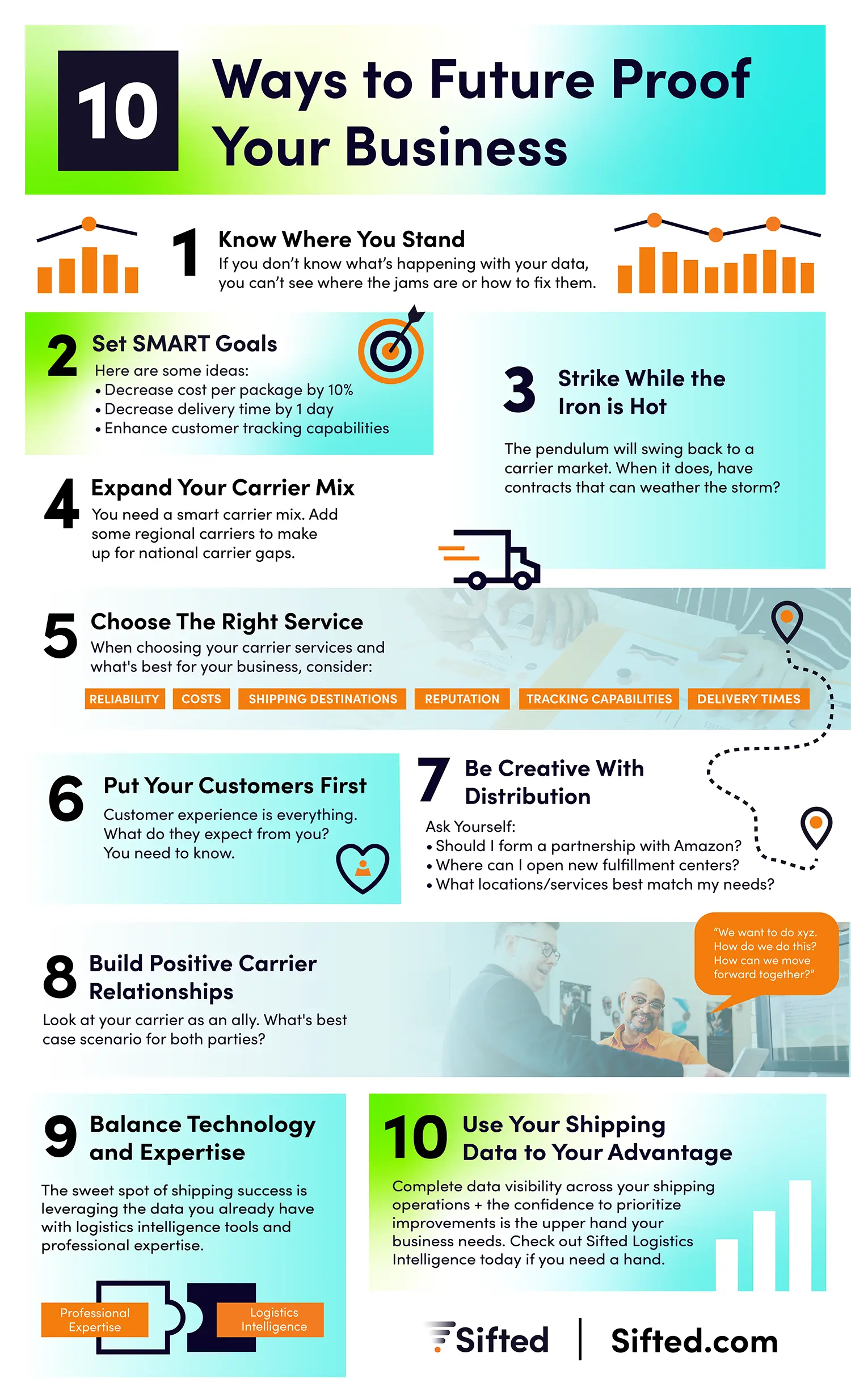
1. Know Where You Stand
Visibility into your shipping operations and carrier contracts is essential to smart prioritization and planning. But if you don’t know what’s happening with your data, you can’t see where the bottlenecks are or how to fix them. And it’s impossible to find those pipelines inside static tables. For example:
- Where are you spending the most?
- How are costs trending over time?
- Are you hitting your min tier discounts?
- Are your customers happy?
Start by analyzing your shipping profile to understand areas of opportunity. Then you’ll know where you stand and what goals you can set.
2. Set SMART Goals
Don’t know where to start? Here are some ideas:
- Establish supply chain KPIs (ex., inventory accuracy, lead time, delivery time, order accuracy, warehousing costs).
- Revisit free shipping policies
- Decrease cost per package by 10%
- Decrease delivery time by 1 day
- Add a 3PL to your network
- Enhance customer tracking capabilities
- Analyze box sizes and reduce unnecessary packaging
3. Strike While the Iron is Hot
An uncertain economy, high fuel costs, and inflation will all contribute to this year’s GRI. But the biggest impact will be the rising costs of labor.
UPS’ recent agreement with the Teamsters is estimated to cost about $30 billion in additional spending.
Meanwhile, FedEx pilots recently rejected a tentative agreement, which would have increased pay by up to 30%, signifying that FedEx may have to offer even higher rates to reach an agreement.
FedEx and UPS will be looking to shippers to absorb those costs.
Take a look at your carrier agreements now.
- Timing is the best it has been in 3 years to approach carriers and reopen agreements.
- The pendulum will swing back to a carrier market. When it does, you want an agreement that can weather the storm.
- If you are not operationally or systemically married to a single carrier, this is a perfect time to pursue an informal RFQ. Carrier diversification and understanding your shipping data is key.
4. Expand Your Carrier Mix
Add some regional carriers to make up for national carrier gaps.
Regional carriers can add flexibility, faster delivery times, cost reduction, and a less complicated network. It no longer makes sense to ship with one carrier–you need a smart carrier mix.
5. Choose the Right Service
Are you using the right service type for your business needs?
It’s the little things that add up. Ex. If you’re shipping two doors down – don’t ship overnight – ship it ground in less than a day.
When choosing your carrier services and what’s best for your business, look at the carrier’s:
- Reliability
- Costs
- Shipping destinations
- Reputation
- Tracking capabilities
- Delivery times
6. Put Your Customers First
Your customer experience is everything.
Rising expectations of free and two-day shipping are creating high-pressure situations for shippers–can you meet those expectations?
- How quickly do customers expect their products to arrive?
- Do the products require special requirements? (time or temperature-sensitive products)
- What’s best: free shipping or lower prices? (offer free shipping where it makes sense, i.e., the zero price effect)
Start pivoting now to be an earlier adopter—and customers will recognize that. Plus, you stay ahead of the competition and industry evolutions.
Overnight shipping, for example, is closer than you think. And Amazon? They could come in as a national carrier tomorrow.
7. Be Creative With Distribution
Think like Amazon. How do they reach so many customers quickly? They have a massive network of distributors, making it easy to get products out. Did you know that you can use Amazon warehouses to enhance your network and do the same thing?
Important note: be mindful of your current agreements with UPS and FedEx. Depending on how much inventory you shift to Amazon, you risk dropping down a tier with your current services.
Start by asking yourself some vital questions:
- Should I form a partnership with Amazon?
- Where can I open a new distribution/fulfillment center or use 3PLs to increase my network?
- What locations and services best match my shipping needs?
Example: If most of your client base is in DC, but your fulfillment center is in LA, you may want to consider a DC move. If that’s not an option, opt for opening an additional center closer to your client base.
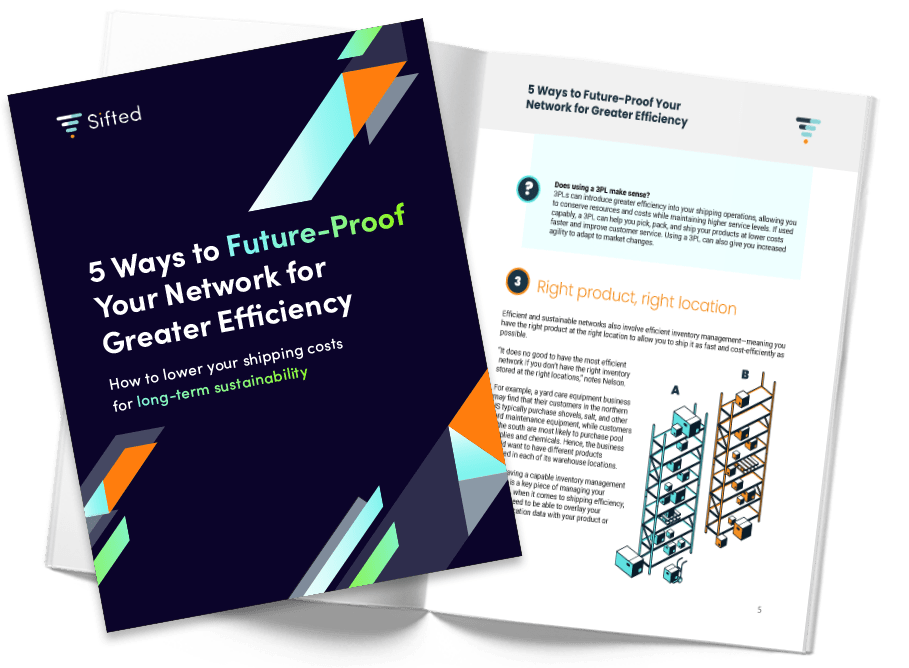
Future-Proof Your Network for Greater Efficiency
8. Build Positive Carrier Relationships
Look at your carrier as an ally to your business, not an enemy.
Like any service provider, carriers have a reputation to uphold. And you can work together to remove stress from your operations with their support. Ask your carrier for help with getting your products out faster, switching to a service that better matches your needs, or even suggestions on their end to enhance your efficiency.
Use the relationship to your advantage.
Start approaching your reps with a common goal “We want to do xyz. How do we do this? How can we move forward together?” They can also offer operational efficiency on their end—it’s a win-win for everyone.
9. Balance Technology and Expertise
The sweet spot of shipping success is leveraging the data you already have with logistics intelligence tools and professional expertise.
Most of the time, people don’t have true visibility into their data. It’s been a PDF and spreadsheets world – i.e., excel hell (Ever had your excel sheet freeze up?)
Using Excel, it’s impossible to obtain the vital shipping visibility you need across all your carriers. You need to see in real-time how your shipping profile is performing (and what you should do about it) across key supply chain metrics like shipping charges by service type, package count, transit time, average cost, and more.
Upgrade your operations with the right tools and technology that make it easy to ingest and normalize your data.
10. Use Shipping Data to Your Advantage
Complete visibility across your shipping operations is the upper hand your business needs.
With Sifted logistics intelligence, you have all your shipping data in one place. You see at glance where you stand, where you’ve been, PLUS how you can improve.

We provide you with a clear ranking of where you stand with a Sifted Score. Your Sifted Score is like a credit score for your shipping profile. The higher your score (the closer you are to green), the better your shipping health.
Clear data allows you to see the unnecessary fees and inefficiencies and use that to your advantage.
Improve today to build a better tomorrow
Take your shipping business to the next level with Sifted Logistics Intelligence and secure your future with the right balance of technology and tools. Sign up for a free demo today.